Ho’oponopono can help restore harmony within, and with others
When I first encountered the practice known as Ho-oponopono, it was in an interview with Heleaka Hew Len PhD, a Hawaiian psychologist and shamanic practitioner. I took on the simple yet profound forgiveness practice and found immediate benefits in my personal life.
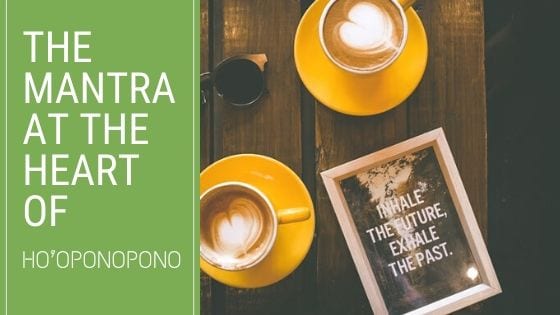
Ho’oponopono: I’m sorry, please forgive me, thank you, I love you.
Ho’oponopono: I’m sorry, please forgive me, thank you, I love you.
What is ho’oponopono?
On the surface level, many people have understood ho’oponopono to be a mantra where one repeats the words ‘I’m sorry, please forgive me, thank you, I love you’ as a form of mental and spiritual cleaning that could be compared to buddhist techniques for clearing karma. It has been defined as a forgiveness and reconciliation practice, cleansing of ‘errors of thought’ – the origin of problems and sickness in the physical world, according the the Hawaiian worldview. The literal translation is ‘to put to right; to put in order or shape, correct, revise, adjust, amend, regulate, arrange, rectify, tidy up, make orderly or neat.”
The mantra at the heart of Ho’oponopono
At first glance I found it hard to remember the order of the words or even discern if there was a specific order for them at all, so I tried them in every possible combination as well as repeating them on their own. I chanted them over and over in the hope of discovering whether they were useful in some way and if so, what was it about these words that made them helpful.
As I did so, I found that many questions arose, with different questions coming up depending on the order I said them. “Why should I be sorry? What do I have to be sorry for? What do I need forgiveness for, in this moment and in my life? What do I have to be grateful for? When I say ‘I love you’ am I really feeling it? If not, what is in the way?”. I worked with these words both to directly address something I was finding challenging, as well as just chanting them with no purpose in mind at all.
I found that by simply chanting these words that my inner discordance, my stuff, would come up. Not only would it come up, but it was as if my inner disharmony was being tuned to the frequency of these words and the intention they carry. Over time I found these four simple concepts acted like tuning forks, each carrying a different tone of purity that I could use to tune the disharmonious parts of myself. Best of all, I found that applying this chant to the chaos of my mind brought about stillness and calm.
The only problem with human beings is that they are arrogant, because that’s what thinking is. This is in essence ‘I know’. Wisdom is being in the void. To be thoughtless. Only by being in the void can the Light come through. As long as I have something going on in my mind the Light can’t come through. The Light can only come in when the mind is cleared – in a state of silence. – Dr Hew Len, Shamanic Wisdomkeepers

Why is Ho’oponopono powerful?
Throughout human history we have been divided by distance, language, cultural and religious beliefs, class and economic hierarchy. Whenever someone comes up with a perspective there seems to always be someone else there with an opposing opinion. To me the power of Ho’oponopono comes, in large part, from the fact that it’s a really rare thing for the vast majority of humanity to be in agreement about anything.
Across all cultures practically all of us agree that the concepts of thank you, I’m sorry, please forgive me and I love you are all valuable and important. If there is such thing as a collective consciousness, as Jung and many eastern traditions have suggested, then the basis of the power of Ho’oponopono may come from the sheer volume of people throughout human history who have agreed that these concepts are valuable, important and useful to humanity. In this way, Ho’oponopono may be tapping into a level of awareness that extends far beyond its Hawaiian roots into perhaps every culture that has ever existed on Earth.
In common with other shamanic traditions, the Hawaiian tradition teaches that all life is connected. Ho’oponopono is, therefore, not only a way of healing ourselves, but others and our world as well.
– Timothy Freke, Shamanic Wisdomkeepers
Can Ho’oponopono affect more than our internal world?
At the core of Dr Hew Len’s perspective is the idea of taking responsibility for more than your personal self because ‘you are in me and I am in you’. His way of expressing Ho’oponopono contains an awareness that the discordance we find in others and in the world outside ourselves is due to ‘errors’ in thought stored in our personal and collective memories. The belief in these errors existing in some form of collective memory accessible to all allows for a person practicing Ho’oponopono to clean these errors, whether the error originated in their personal thoughts or not.
I don’t see myself as a kahuna, I see myself as a garbage collector. I’m only here to be responsible and it’s often very hard to do that. – Dr Hew Len, Shamanic Wisdomkeepers

The paradox here is that he is advocating development of personal power to change the situation around us through increasing personal responsibility, which involves a willingness to take on responsibility for cleaning discordance that was not created by oneself, i.e doing other people’s inner work for them (which doesn’t seem like the other taking personal responsibility for them self). As usual, the paradox is resolved with the awareness that separation consciousness is not the only reality and an underlying unity also co-exists, after all: ‘you are in me and I am in you’. This is where ho’oponopono truly steps into being a shamanic practice, where the reality not only within but around the practitioner can apparently be adjusted.
No one wanted the job I did with the criminally insane. They were averaging about one psychologist a month. But I got asked. We had about 25-30 people. Half of them would be in shackles at the ankles or the wrists because they were dangerous. They could either kick you or slam you. Everyone would walk with their back toward the wall so that they wouldn’t get struck. They had no family visits. No one could leave the building. A year and a half later there was none of that. There were people going out on bus rides. Nobody in shackles. The level of medication dropped. What did I do? I worked on myself. I took 100% responsibility. – Dr Hew Len, Shamanic Wisdomkeepers
While the rational part of me would still like verification that this story really happened, it evoked enough curiosity in me to get me to try the technique and find out for myself if might be helpful to my life.
Ho’oponopono as a family therapy practice.
For people living in Hawaii today Ho’oponopono is less about it being a personal shamanic practice through chanting a mantra internally or externally, and more about a traditional system of dispute resolution. It’s a practice that still holds the values of making things right and correcting errors, however in this incarnation it is focused on making things right with our relations; coming back into right relationship by correcting errors with living relatives, ancestors and deities.

Today Ho’oponopono is just like family therapy. This has been really influenced by the Christians. But I’m talking about the real Ho’oponopono from before they came. [Back] then the Hawaiians didn’t need to talk anymore. They could go straight to the Light. This is very ancient. It goes back to the start, because that’s where Hawaiians came from. – Dr Hew Len, Shamanic Wisdomkeepers
The ritual for group reconciliation itself involves an elder in the family convening the process, or if this isn’t possible an elder from the wider community. The ideal situation is for the ritual to be conducted by praying priest (kahuna pule) or healing priest (kahuna lapaʻau) particularly if illness was involved.
The process begins with prayer. A statement of the problem is made, and the transgression discussed. Family members are expected to work problems through and cooperate, not “hold fast to the fault”. One or more periods of silence may be taken for reflection on the entanglement of emotions and injuries. Everyone’s feelings are acknowledged. Then confession, repentance and forgiveness take place. Everyone releases (kala) each other, letting go. They cut off the past (ʻoki), and together they close the event with a ceremonial feast, called pani, which often included eating limu kala or kala seaweed, symbolic of the release. – Nana I Ke Kumu (Look To The Source) by Mary K. Pukui, E.W Haertig, Catharine Lee.

Creating space for confession, repentance and forgiveness to take place
Testing The True Power Of Ho’oponopono
Like many spiritual practices, such as meditation, it’s not the practice you do while you’re in the crisis, it’s the practice you do on a regular basis between the crisis that makes it effective when the storm hits. A couple of years ago I was at a spiritual retreat where the practice I was engaged in triggered what I would now describe as a state of spiritual emergency. I use this term in the context that Stan Grof and other transpersonal psychologists might use it, as an alternative way of describing what others might call psychosis.
I was in a mindset where I felt emotionally and spiritually assaulted, and was by far feeling more threatened than I had ever experienced in my life. Upon the realisation that no-one was coming to help me, I knew that it was up to me to deal with the situation. I sat down on the spot and went into meditation. Out of the many chants and tools I have learned over the years, it was Ho’oponopono that came to me as the solution to my situation.
Within moments of implementing the practice the feeling of all out assault on my consciousness cleared as easily as the smell of burnt toast when one opens the windows on a day with a fresh breeze. When I was found I was meditating quietly in a state of peace and gentleness and the challenge of a potentially full blown psychotic episode had dissolved and has not since returned. I share this not to state what will definitely happen to others who choose to use this practice, but to simply illustrate what may be possible.
Written By Jonathan Davis
Source: Uplift Connect
Discover More Articles Like This
Testing The True Power Of Ho’oponopono
Like many spiritual practices, such as meditation, it’s not the practice you do while you’re in the crisis, it’s the practice you do on a regular basis between the crisis that makes it effective when the storm hits. A couple of years ago I was at a spiritual retreat where the practice I was engaged in triggered what I would now describe as a state of spiritual emergency. I use this term in the context that Stan Grof and other transpersonal psychologists might use it, as an alternative way of describing what others might call psychosis.
I was in a mindset where I felt emotionally and spiritually assaulted, and was by far feeling more threatened than I had ever experienced in my life. Upon the realisation that no-one was coming to help me, I knew that it was up to me to deal with the situation. I sat down on the spot and went into meditation. Out of the many chants and tools I have learned over the years, it was Ho’oponopono that came to me as the solution to my situation.
Within moments of implementing the practice the feeling of all out assault on my consciousness cleared as easily as the smell of burnt toast when one opens the windows on a day with a fresh breeze. When I was found I was meditating quietly in a state of peace and gentleness and the challenge of a potentially full blown psychotic episode had dissolved and has not since returned. I share this not to state what will definitely happen to others who choose to use this practice, but to simply illustrate what may be possible.
Written By Jonathan Davis
Source: Uplift Connect

Ginger Crunch
How to make a Ginger Crunch This spicy and sweet Mana Recipe is easy to prepare at home with only a few simple ingredients. Enjoy paired with a warm cup

Why Your Voice Is The Fastest Way Back To Yourself
Julia Williamson is a transformational voice coach, professional singer and songwriter with over 35 years of experience helping people reconnect with their voice as a pathway to healing, authentic expression

ReWild: An Exploration of Power Purpose and Belonging
Many men carry a quiet longing, for greater purpose, deeper connection, and a sense of belonging that goes beyond achievement or success. Ahead of this year’s ReWild retreat, we spoke